
In 1822, Thomas Jefferson had had enough. The US Supreme Court under Chief Justice John Marshall had decided a number of landmark cases in the previous few years without a breath of dissent, without one of the seven justices opining something other than what Marshall wrote (as he almost always did) as the Unanimous Opinion of the Court.
Cohesion, one voice was Marshall’s intent. He kept a tightly knit court. They were a group of men who met in a basement room beneath the Capitol. They lived together in a boarding house, stayed up late discussing matters of the day. The public and the legislature alike allegedly held one of two sentiments with respect to the Court’s dealings and doctrine: distaste or indifference. And so to create cohesion, Marshall’s court discoursed behind closed doors, emerging with a single decision in a single voice. United they stood.
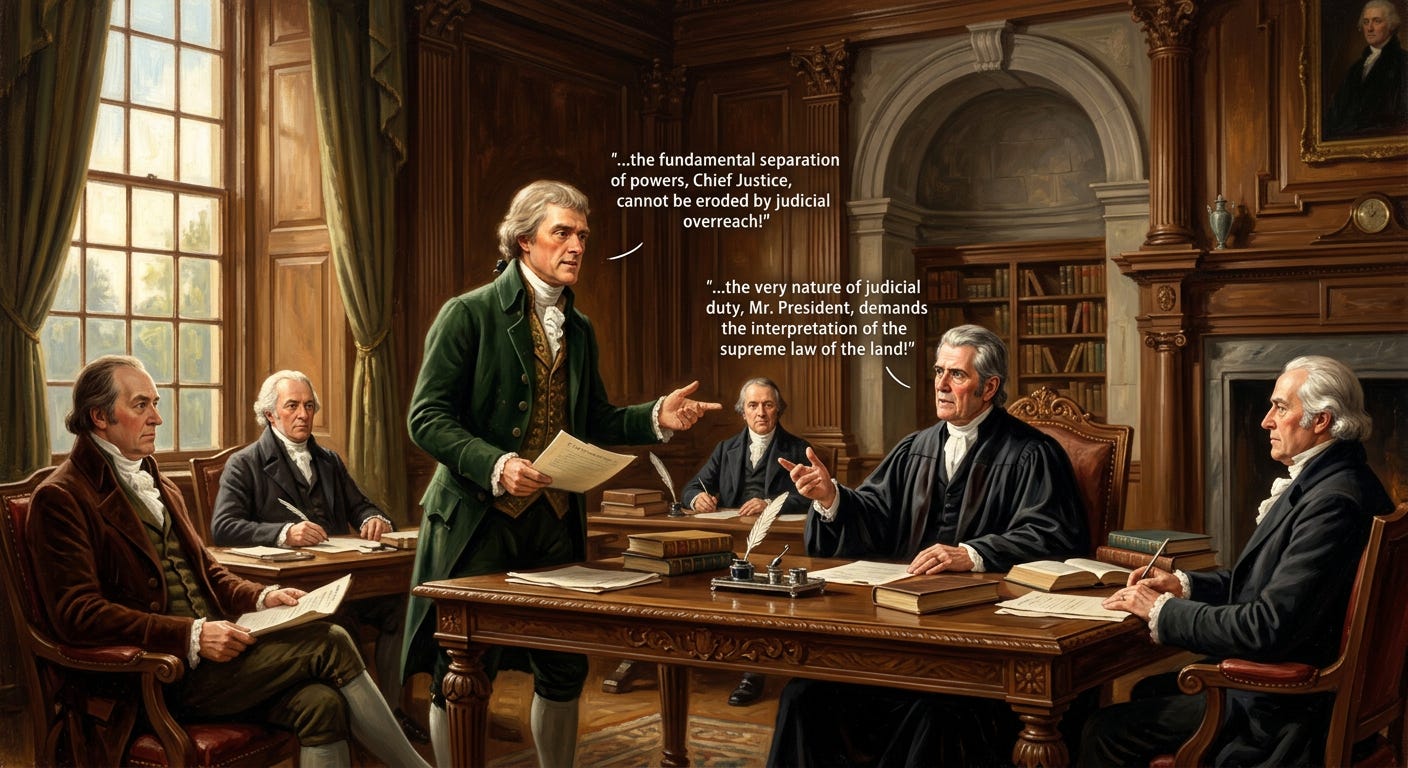
Jefferson took offense. The justices, he said, having been appointed for life, answered to only impeachment (of their decisions) and individual reputation (public opinion). Without opinions in seriatim (each man providing his own decision), they were excused from those checks. “The practice is certainly convenient for the lazy, the modest & the incompetent,” Jefferson wrote in a letter to Associate Justice William Johnson.
Marshall responded by publicly asserting that any opinion his court gave was unanimously agreed upon by all justices and that “if any part of the reasoning be disapproved, it must be so modified as to receive the approbation of all…”
Ultimately, Johnson sided with Jefferson and began to write seriatim opinions, both dissenting and concurring. The practice became norm on the court and (although it came and went over the decades since) remains today.
Seriatim opinion, as Jefferson suggested, allows the public to see character, to judge those who ultimately interpret the document that provides and guarantees liberty above all else. Character is evident even within opinions that are more aptly described as non-opinions, such as the dissent given by Chief Justice John Roberts in Obergefell v. Hodges, last week’s SCOTUS case that concluded states do not have the grounds to ban gay marriage.
Non-opinion because in his dissent Roberts writes that the matter had nothing to do with the constitution and therefore was not a matter for the court: “Celebrate the achievement of a desired goal. Celebrate the opportunity for a new expression of commitment to a partner. Celebrate the availability of new benefits. But do not celebrate the Constitution. It had nothing to do with it.”
Valid point—Roberts is a strict reader and textual interpreter of the Constitution—and respectable if the reason he voted to uphold the lower court’s ruling is because he didn’t think the US Supreme had an business hearing the case.
That portion of the dissent tells us much about the thoughtful man: his love of the law, his position on what he thinks the Court is and the purpose it serves. He could have ended there. He could have resisted offering a political view, a social commentary. But he didn’t.
Socially, the curious part of Roberts’ dissent comes with concision in a single sentence in which it seems he took it upon himself to play the part of hobbyist anthropologist.
Marriage, Roberts writes arguing that same-sex unions are unnecessary, “arose in the nature of things to meet a vital need: ensuring that children are conceived by a mother and father committed to raising them in the stable conditions of a lifelong relationship.“
Let’s pull it apart like some tender smoked pork then: Marriage, Roberts argues, was a natural and unavoidable development of society. The original purpose of marriage was to create an environment in which a child or children resulting from intercourse between two people could be raised to the age of self-sufficiency (at minimum), thus perpetuating life. (He writes that this has to be a “lifelong relationship”—but because the beginning of his argument does not claim that part of the original purpose of marriage was to strengthen society, it’s a mystery why the term lifelong is included.)
Behind this sentence is the intimation, a subtle reminder of the fact that a woman and another woman or a man and another man cannot conceive children. It would seem that Roberts is suggesting if a couple of people cannot conceive a child, there is no need for them to be married.
If that’s the case, it goes against the beginning of his argument—and Roberts is arguing against himself.
What a child needs, in Roberts’ words is a stable environment. How that child came into being is immaterial. Naturally some environments are unstable; some marriages crumble; the minds of some parents are unsound; the needs of some children cannot be met. It goes on.
We should want, as a society, to find stable environments for children who would otherwise be lost along the way.
With the advent of seriatim opinion on the Supreme Court, we are able to acknowledge the bitter parts of our best legal minds such as Chief Justice John Roberts.
And with the advent of same sex couples being allowed to form their legal and therefore more stable unions, we are able to create more loving, nurturing environments that will lead to a stronger, healthier, more stable future generations.
Celebrate that, Mr. Roberts.
Oh. And Bobby Jindal is a crazy person.