
Kurt Vonnegut never wrote a story with a villain in it. He learned this from an anthropology class at his university where they taught, according to Vonnegut, “…that nobody was ridiculous or bad or disgusting,” and that everyone was the same.
Some stories have villains. Some very good stories have villains. When they do, these stories often cheat to get around the truth KV learned as a 19-year-old. When they do have villains — when they have good, pure, altruistic protagonists, in fact — these stories are either parables, or allegoric fantasies, or very selective, short glimpses into certain periods of characters’ lives — or the characters are something other than Human, something other than healthy humans; they are stupid or imbalanced or otherwise deranged. If a story is true in a broad, timeless sense, its characters can be neither good nor bad nor evil because those things cannot exist on an infinite timeline; i.e. we never know the final result of a choice because we never know “final.”
Characters that truly represent us, humans, people — those characters just are. Their motivations changes. Their moral vicissitudes alter their choices. Their relationships to other characters fluctuate based on whim or mood. They are us. Often in a story that’s hard to capture because in life it happens at a unobservable rate, and if that rate is increased, the story seems like a children’s show, meant to instruct, rather than reflect. Boring and annoying.
However, there is one show on what-we-used-to-call-TV right now that gets this reflection correct, vicissitudes and all: The Handmaid’s Tale.
The writing on The Handmaid’s Tale is beautiful because it lives in what isn’t said. Often (I’m almost forced to say always), television writing gets confused with, say, the writing of an novel, and characters will find themselves explaining their actions, whether to cover plot holes, or because the actor isn’t good enough to convey a motivation with a glance, or simply because the writing is burdensome and sloppy and too in love with itself (which I’m guilty of, as well, perhaps presently).
The writing on The Handmaid’s Tale is beautiful because its silences reflect our daily lives, those aches in our chests that heave when we want to tell of bosses, but don’t, when we want to say, I want to kiss you, but can’t… Those silences are the chains of consequence that we feel. Always. Constantly. That “what-if-then-this,” that algorithm that plays out faster-than-light in our minds.
This is why we react well to the show. Much has been said about how The Handmaid’s Tale mirrors the direction in which the Trump Administration seems to be moving America, towards a dystopian, inhuman, authoritarian regime (as if there are authoritarian regimes that don’t inevitably become inhuman), and, ok, maybe. But that’s all guess work, partisan guess work at that.
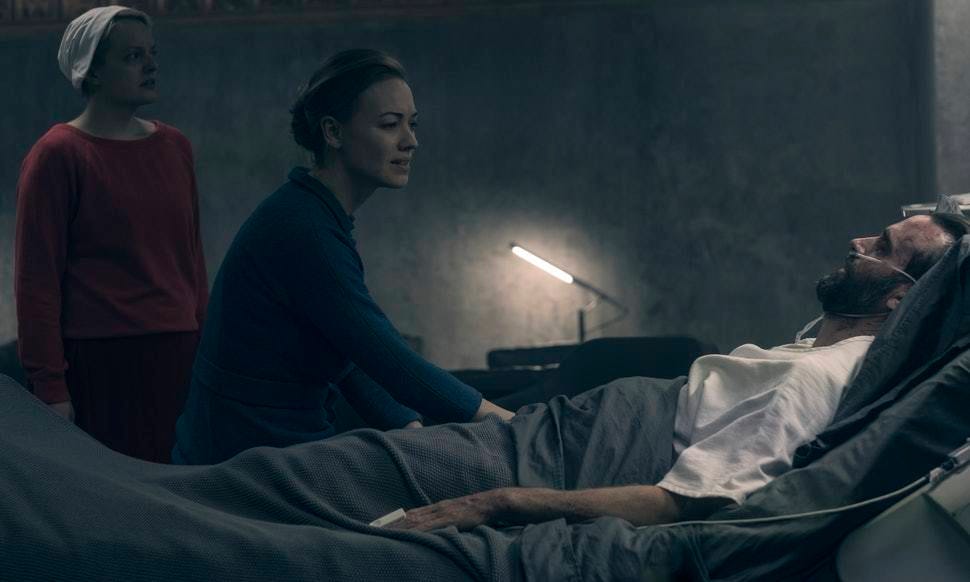
The Handmaid’s Tale is brilliant not because it’s a warning of where we’re going, but because it’s a reflection of where we are.
In show, as in the Trump Administration, relationships change with whiplash rapidity. Ofred and Mrs. Waterford are friends in one episode. The next, their as nasty as demons to one another. In one episode, Commander and Mrs. Waterford are comrades. In the next, they share a deep enmity for one another that could slit a throat were it manifested. And this comparison isn’t unique to the Trump White House. This is how we each live, every day — because this is how we survive with each other.
On a long enough timeline, we are all heroes. We are all villains. We all do what we think is right and explain-away when we do something wrong. The Handmaid’s Tale gives us that. Were Vonnegut alive, it may be the one show he’d watch — whenever he wasn’t busy making fun of Geraldo (Jerry Rivers) Rivera.
Under His Eye.